
What’s New & Beneficial About Garbanzo Beans a.k.a Chickpeas
 There’s now direct evidence about garbanzo beans and appetite! Participants in a recent study reported more satisfaction with their diet when garbanzo beans were included, and they consumed fewer processed food snacks during test weeks in the study when garbanzo beans were consumed. They also consumed less food overall when the diet was supplemented with garbanzo beans.
Garbanzo beans (like most legumes) have long been valued for their fiber content. Two cups provide the entire Daily Value! But the research news on garbanzos and fiber has recently taken us one step further by suggesting that the fiber benefits of garbanzo beans may go beyond the fiber benefits of other foods. In a recent study, two groups of participants received about 28 grams of fiber per day. But the two groups were very different in terms of their food sources for fiber. One group received dietary fiber primarily from garbanzo beans. The other group obtained dietary fiber from entirely different sources. The garbanzo bean group had better blood fat regulation, including lower levels of LDL-cholesterol, total cholesterol, and triglycerides.
In some parts of the world (for example, parts of India), garbanzo beans are eaten daily in large amounts and on a year-round basis. But a recent study has shown that we can obtain health benefits from garbanzo beans even when we eat much smaller amounts over a much shorter period of time. In this study, it took only one week of garbanzo bean consumption to improve participants’ control of blood sugar and insulin secretion. Equally important, only one-third cup of the beans per day was needed to provide these blood-sugar related health benefits.
Garbanzos are a food you definitely want to keep on your “digestive support” list – especially if you are focusing on the colon. Between 65-75% of the fiber found in garbanzo beans is insoluble fiber, and this type of fiber remains undigested all the way down to the final segment of your large intestine (colon). Recent studies have shown that garbanzo bean fiber can be metabolized by bacteria in the colon to produce relatively large amounts of short chain fatty acids (SCFAs), including acetic, propionic, and butyric acid. These SCFAs provide fuel to the cells that line your intestinal wall. By supporting the energy needs of our intestinal cells, the SCFAs made from garbanzo fibers can help lower your risk of colon problems, including your risk of colon cancer.
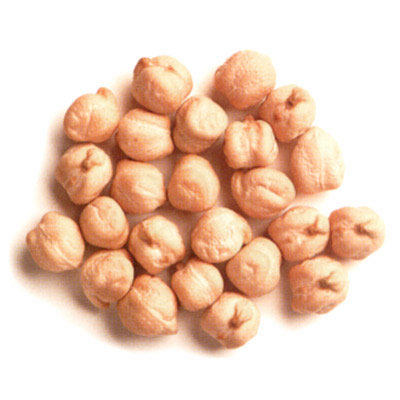
Most garbanzo beans found in the grocery (especially canned garbanzos) are cream-colored and relatively round. This type of garbanzo bean is called the “kabuli-type.” Worldwide, there’s a far more common type of garbanzo bean called the “desi-type.” This second type of garbanzo bean is about half the size of cream-colored type we’re accustomed to seeing in the grocery, and it’s more irregular in shape. The color is also different – varying from light tan to black. Researchers have recently determined that many of the antioxidants present in garbanzo beans are especially concentrated in the outer seed coat that gives the beans their distinctive color. Darker-colored “desi-type” garbanzo beans appear to have thicker seed coats and greater concentrations of antioxidants than the larger and more regularly shaped cream-colored garbanzos that are regularly found at salad bars and in canned products. Of course, it is important to remember that antioxidants can be found in both types of garbanzo beans and you’ll get great health benefits from both types. But if you have previously shied away from darker-colored or irregularly-shaped garbanzo beans, we want to encourage you to reconsider and to enjoy all types of garbanzo beans, including the darker-colored and irregularly-shaped ones.
WHFoods Recommendation
 Many public health organizations-including the American Diabetes Association, the American Heart Association, and the American Cancer Society-recommend legumes as a key food group for preventing disease and optimizing health. The 2005 Dietary Guidelines for Americans developed by the U.S. Department of Health and Human Services (USDHHS) and the U.S. Department of Agriculture (USDA) recommends 3 cups of legumes per week (based on a daily intake of approximately 2,000 calories). Because 1 serving of legumes was defined as 1/2 cup (cooked), the Dietary Guidelines for Americans come very close to this as they recommend of 1/2 cup of cooked legumes on a daily basis. Based on our own research review, we believe that 3 cups of legumes per week is a very reasonable goal for support of good health. However, we also believe that optimal health benefits from legumes may require consumption of legumes in greater amounts. This recommendation for greater amounts is based upon studies in which legumes have been consumed at least 4 days per week and in amounts falling into a 1-2 cup range per day.
These studies suggest a higher optimal health benefit level than the 2005 Dietary Guidelines: instead of 3 cups of weekly legumes, 4-8 cups would become the goal range. Remember that any amount of legumes is going to make a helpful addition to your diet. And whatever weekly level of legumes you decide to target, we definitely recommend inclusion of garbanzo beans among your legume choices.”
For the rest of the article, please click here!
Hummus Recipe
Prep Time: 10 minutes
Total Time: 10 minutes
Ingredients: 1 can garbanzo beans/chickpeas 1/4 cup olive oil 1 tablespoon lemon juice 1 teaspoon cumin
Preparation: In a food processor, blend all ingredients together until smooth and creamy. Serve immediately with pita bread, pita chips, or veggies. Store in a airtight container for up to three days.
See also Growing Chickpeas: How to Grow Chickpeas and Care for Them